


Security Predictions for WordPress in Late 2026
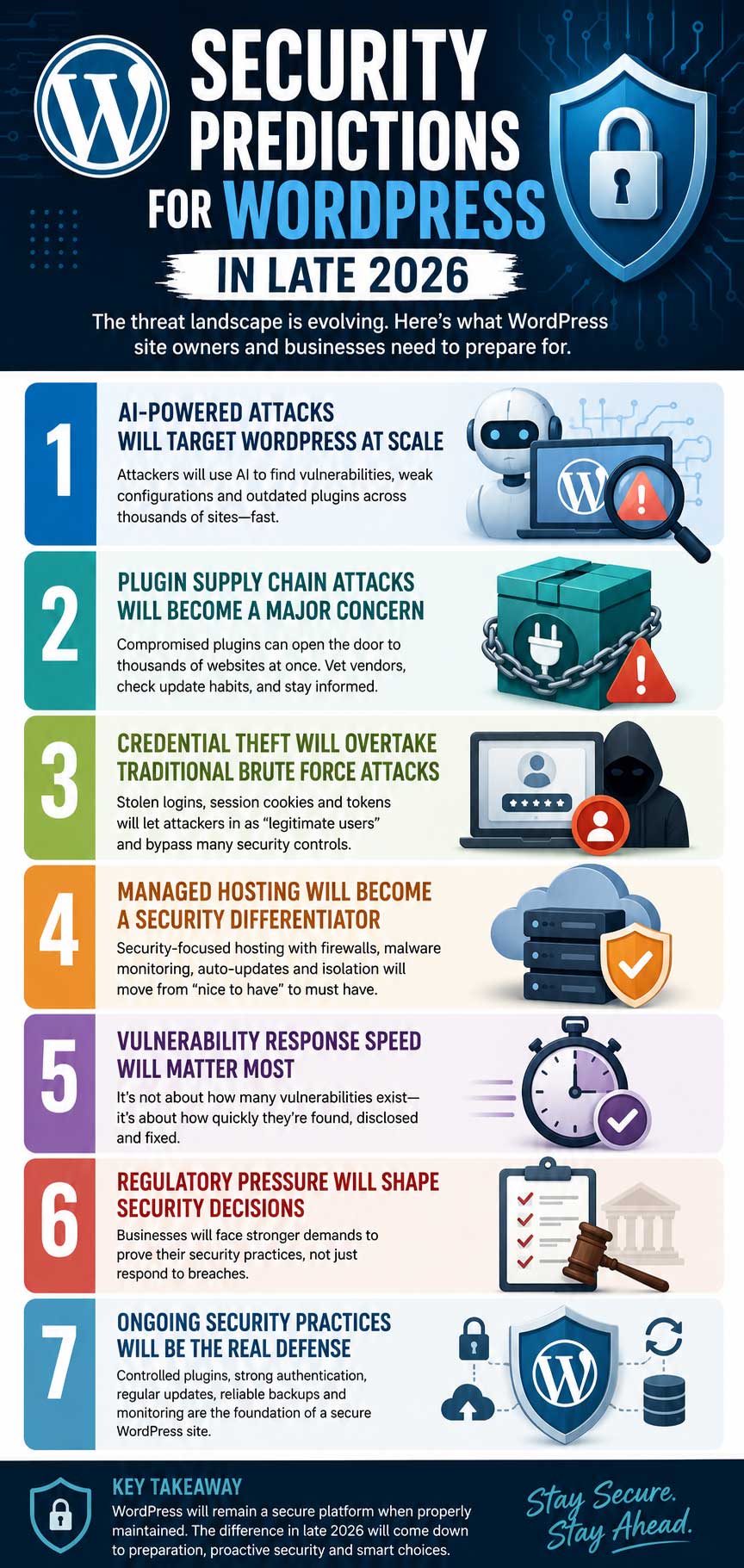 WordPress remains the most widely deployed content management system on the web, which means it continues to attract a disproportionate share of attention from cybercriminals. By the second half of 2026, the threat landscape surrounding WordPress is likely to look very different from what site owners faced only a few years ago. The biggest risks will not come from WordPress core itself. Instead, attackers will focus on the growing ecosystem of plugins, AI-assisted attack automation, cloud infrastructure weaknesses, and compromised supply chains.
AI-Powered Attacks Will Target WordPress at Scale
Security teams spent much of 2024 and 2025 experimenting with defensive AI tools. During late 2026, attackers are expected to gain equal benefit from the same technologies.Rather than manually scanning websites for vulnerabilities, threat actors will increasingly use AI systems capable of identifying outdated plugins, exposed configuration files, weak login practices, and misconfigured hosting environments. What once required skilled operators and significant time investment can now be performed across thousands of websites simultaneously.
Smaller businesses will be particularly vulnerable. Many assume they are too small to attract attention, yet automated reconnaissance does not discriminate between a multinational retailer and a local service company. If a weakness exists, it can be found and exploited within minutes.
Plugin Supply Chain Attacks Will Become a Major Concern
For most WordPress sites, plugins deliver the functionality that powers forms, e-commerce, SEO, analytics, membership systems, and customer engagement. That convenience comes with risk.Over the next year, security researchers are likely to uncover more incidents where legitimate plugins are compromised during development, maintenance, distribution, or update processes. Attackers no longer need to breach thousands of websites individually. Gaining access to a widely used plugin can provide a route into every site running that software.
Site owners who install plugins solely on the basis of popularity may face difficult choices. Vendor reputation, security history, update frequency, and development transparency will become more important purchasing criteria than feature lists alone.
Credential Theft Will Overtake Traditional Brute Force Attacks
Classic brute-force login attacks are unlikely to disappear, but they are becoming less effective against organisations that have adopted strong password policies and multi-factor authentication.Criminal groups are shifting toward credential theft campaigns that harvest usernames, passwords, session cookies, and authentication tokens from compromised devices. Once valid credentials are obtained, attackers can bypass many traditional security controls and appear to be legitimate users. Website administrators should expect more account takeover incidents originating from compromised endpoints rather than direct attacks against the WordPress login page.
Managed Hosting Providers Will Become a Security Differentiator
In previous years, website owners often selected hosting based on price and performance. Security capabilities are becoming a more influential factor. Late 2026 may see a wider gap emerge between low-cost hosting providers and security-focused managed WordPress platforms. Continuous malware monitoring, automated patch deployment, isolated container environments, web application firewalls, and behavioural threat detection are moving from premium extras to baseline expectations.Businesses handling customer data, payment information, or lead generation activities will increasingly view hosting security as part of their overall risk management strategy rather than a technical procurement decision.
Vulnerability Disclosure Speed Will Matter More Than Vulnerability Counts
Many organisations still evaluate software risk by counting vulnerabilities. That approach misses a critical detail.No software ecosystem is free from security issues. The real distinction lies in how quickly vulnerabilities are identified, disclosed, patched, and deployed. During late 2026, response speed is likely to become one of the most important indicators of WordPress security maturity. Plugin developers capable of releasing fixes within hours or days will gain trust. Vendors with slow disclosure practices or irregular maintenance schedules may find themselves abandoned by security-conscious customers.
Regulatory Pressure Will Influence Website Security Decisions
Data protection requirements continue to evolve across multiple jurisdictions. Security failures are increasingly viewed as governance failures rather than purely technical incidents.Organisations operating WordPress websites will face stronger pressure to demonstrate patch management procedures, access controls, backup policies, and incident response planning. Security documentation may become just as important as security technology. For many businesses, the question will no longer be whether they have experienced a breach. Stakeholders will want evidence that reasonable preventative measures were in place before any incident occurred.
The Future of WordPress Security
The strongest WordPress sites in late 2026 will not necessarily be the ones running the most security plugins. They will be the sites built around disciplined operational practices: controlled plugin usage, rapid patching, strong authentication, reliable backups, hardened hosting environments, and continuous monitoring.WordPress itself is likely to remain a secure platform when properly maintained. The greater challenge will be managing the expanding ecosystem that surrounds it. Organisations that treat website security as an ongoing business process rather than a one-time technical project will be in the best position to withstand the next generation of threats.